Tuesday, October 2, 2012


SANTIAGO SIERRA

Spanish conceptualist sculptor and performance artist Santiago Sierra (b.1966) won’t talk about his background or have his portrait taken, yet for someone so seemingly shy his works are very contentious and often extremely confronting.

His performances focus on the inequality of the social and economic systems using the marginalised of society, such as the unemployed, dispossessed, illegal immigrants and prostitutes as his ‘performers’. These performer’s were ‘paid’ , however, their ‘payment’ could be seen as being ‘equivalent’ to their ‘life story’, for example,  ‘In 2000 he hired a tattooist to tattoo a continuous thin line across the backs of four drug-addicted prostitutes in return for the price of one hit of heroin.


160 cm Line Tattooed on 4 People El Gallo Arte Contemporáneo. Salamanca, Spain. December 2000 
Sierra’s events test individual and social boundaries to expose social and cultural inequalities1
 

In 2010 Santiago produced a piece for John Kaldor’s Project 22, titled


7 forms measuring 600 x 60 x 60 cm constructed to be held horizontal to a wall, in which he unifies ‘sculpture and performance to create a physical portrait of the labor economy. Hired for the minimum wage, the employees hold monolithic structures on their shoulders for the duration of a working day. They recall the caryatid or atlas figures whose sculpted forms stand as pillars to support the weight of classical architecture. Carrying casket-like forms on their shoulders, they represent what Sierra calls the ‘social burial’ of labor..... Sierra stipulated that they must be paid the minimum wage and be genuinely in need of work.’2  
Santiago Sierra’s performances are remarkably confronting and thought provoking due to reality of the ‘performers’ lives and the public nature of these works. 

1. http://kaldorartprojects.org.au/project-archive/santiago-sierra-2010
2. http://kaldorartprojects.org.au/project-archive/santiago-sierra-2010

Monday, October 1, 2012

Guillermo Calzadilla & Jennifer Allora


Stop, Repair, Prepare

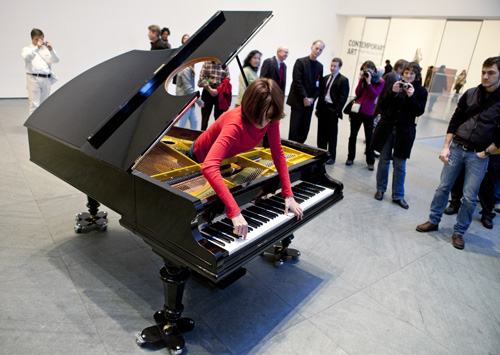
Guillermo Calzadilla & Jennifer Allora’s artistic practice is one routed in collaboration and the two have worked together since 1995. Their artistic practice is interdisciplinary and utilizes sculpture, performance, sound, video and photography. Routed deeply in conceptual practice the works are usually quite political (a reflection no doubt of being based in San Paulo). Included in the 26th Kaldor project their work  Stop, Repair, Prepare a ‘sculptural performance consist[ing] of a grand piano with a hole in its body through which a pianist stands and plays Beethoven’s “Ode to Joy” (the anthem of the European Union as well as the inauguration song for a Nazi propoganda building) while laboriously pushing the instrument around the space’.[1]

A work that is no doubt Euro centric in its use of motifs but one that would no doubt performed in the State Library of Victoria is one that is not removed of its political agenda. This choice of site being one that is the usual meeting place for any protest worth the media’s attention in Melbourne. The Piano is utilized not only for its sonic capabilities but also for an aesthetic of High class. When modified to be played form an unconventional stance (this being from inside the body) the work is transformed into a vehicle for a voice that seeks to also play upon the expected conceptions of Beethoven’s musical piece. The violence of the aural sound (encapsulated in its use of the Nazi regime) is questioned by this utilization in an unconvential manner.


[1] Motta, Carlos. “Allora and Calzadill”, Bomb Magazine (2009)

Tatzu Nishi

Tatzu Nishi is a Japanese artist, based in Germany, whose artistic practice focuses on historic monuments and sculptures.

 
Tatzu Nishi, War and peace and in between, 2009


 For Nishi's Kaldor Project, War and peace and in between, he constructed a room around two enormous equestrian bronzes Offerings of Peace and  Offerings of War, by Gilbert Bayes (1923). The viewers find themselves in a normal domestic living room and bedroom except the giant horse and rider wedged into a cabinet and the other on top of the bedsheets. 


Tatzu Nishi, War and peace and in between, 2009

His works invite the audience to look at his works through "fresh eyes" that question their national statuary in a critical way. His installation's are site-specific and are displayed in public places in which he constructs a box-like domestic space around them. Nishi places his monumental sculptures in domestic situations flipping context and scale - from public to domestic, impersonal to private.


Sol Lewitt


Sol Lewitt was an American artist who was considered a founding member of numerous movements including minimalism and conceptual art, coining the term he helped establish them as dominant movements of the post-war era. Lewitt was elevated to the public eye in the late 1960s with his wall drawings and sculptures (or “structures” as he preferred to call them). Sol Lewitt worked across various mediums; drawing, printmaking, photography, etc. Being the subject of many solo exhibitions in museums and galleries around the world since 1965, including being invited to Australia by John Kaldor to participate in 'Project 6' (1977) at Sydney's Art Gallery of NSW and Melbourne's National Gallery of Victoria, as well as 'Project 11' which incorporated his new wall pieces rather than his wall drawings which were seen in 'Project 6'.


Sol Lewitt's work 'K 1 2 3 4 5 6 #2' similarly to many of the artist's
 works explore the variations possible within the basic structure of a cube. The simplified cube structure, became the basis of the artist’s three-dimensional work. His work tested the audiences visual and psychological flexibility.

"Conceptual artists are mystics rather than rationalists. They leap to conclusions that logic cannot reach.” - Sol LeWitt

Stephen Vitiello

Stephan Vitiello was born in New York in 1964 and currently lives in Richmond, Virginia. Originally a punk guitarist, Vitiello also produces sound installation works, photographs, performance and sculptural pieces. He has colaborated with many musicians, visual artists and choreographers over the years. Within his installations he shows particular interest with the physical aspect of sound and how it can define the form and atmosphere of an environment.

In 2010 Vitiello produced The Sound of the Red Earth with the Kaldor Public Art Projects. This installation piece was located in the Sydney Park Brickworks. Recordings from the Kimberley region in Western Australia were made and then mixed with other recordings of dusty winds, waterfalls and native wildlife. The recordings were reflections of the different locations Vitiello went to on his trip around that region. A deeply immersive environment was created in this work.


Project 20

 The Sound of the Red Earth
2010
Sydney Park Brickworks, Sydney

  http://kaldorartprojects.org.au/project-archive/stephen-vitiello-2010