Showing posts with label nick. Show all posts

Thursday, October 4, 2012

Annotated Bibliography


Annotated Bibliography
Baudrillard, Jean. Simulacra and Simulation. Translated by Sheila Faria Glaser. United States of America: University of Michigan Press, 1994.

Baudrillards, Simulacra and Simulation is an extensive theoretical analysis of sign systems and the implementation of them into a media soaked and capitalist driven society. Discussions of reality centering around assimilation of signs to be ‘realer than real’ assisted in the chapter ‘The implosion of Meaning in the Media’. Here Baudrillard discuss’ Malcolm McLuhan’s ‘the medium is the message’ in regards to mass media which thus assisted in applying a theoretical framework outside of just visual analysis.


Nakas, Kassandra & Britta Schmitz, edit., The Atlas Group (1989-2004) : a project by Walid Raad. Köln: Buchhandlung Walther König, 2006.

Nakas and Schmitz’s retrospective publication in conjunction with the exhibition of the same title held at Nationalgalerie im Hamburger Bahnhof – Museum für Gegenwart – Berlin provides an extensive breakdown of the groups work I the titled date ranges. This was extremely useful in developing a critical eye that fell simply beyond and archival visual analysis. Particularly in the development of a media centric political reality framework

The Atlas Group Archive. Accessed September 5, 2012. http://www.theatlasgroup.org/

Serving as the online component of the Atlas groups archive the website catalogues all works in the mediums produced. The website (although asked not to be used in course outline) was fundamental in understanding the archives system of cataloguing. It also served as an interesting observation in the sites two loading speeds, this triggering the need to consider what exactly Lebanon’s geographical and contemporary positioning meant in regards to the media critique.

Document Title: Missing Lebanese wars_Notebook Volume 72
by and/or attributed to: Dr. Fadl Fakhouri
date of production: 1989
Number of plates: 20
Dimensions of plates: 25 x 32 cm
Format: Colour photographs

Monday, October 1, 2012

Guillermo Calzadilla & Jennifer Allora


Stop, Repair, Prepare

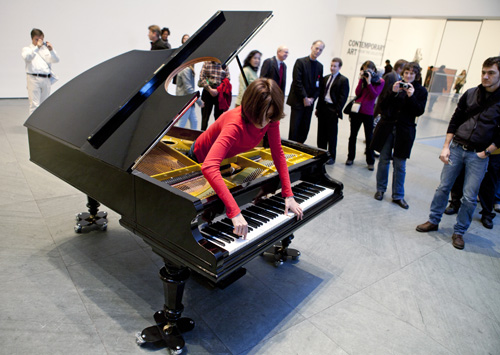
Guillermo Calzadilla & Jennifer Allora’s artistic practice is one routed in collaboration and the two have worked together since 1995. Their artistic practice is interdisciplinary and utilizes sculpture, performance, sound, video and photography. Routed deeply in conceptual practice the works are usually quite political (a reflection no doubt of being based in San Paulo). Included in the 26th Kaldor project their work  Stop, Repair, Prepare a ‘sculptural performance consist[ing] of a grand piano with a hole in its body through which a pianist stands and plays Beethoven’s “Ode to Joy” (the anthem of the European Union as well as the inauguration song for a Nazi propoganda building) while laboriously pushing the instrument around the space’.[1]

A work that is no doubt Euro centric in its use of motifs but one that would no doubt performed in the State Library of Victoria is one that is not removed of its political agenda. This choice of site being one that is the usual meeting place for any protest worth the media’s attention in Melbourne. The Piano is utilized not only for its sonic capabilities but also for an aesthetic of High class. When modified to be played form an unconventional stance (this being from inside the body) the work is transformed into a vehicle for a voice that seeks to also play upon the expected conceptions of Beethoven’s musical piece. The violence of the aural sound (encapsulated in its use of the Nazi regime) is questioned by this utilization in an unconvential manner.


[1] Motta, Carlos. “Allora and Calzadill”, Bomb Magazine (2009)

Wednesday, August 29, 2012

Article SUMmary/Evaluation 'Clock Time' Rosalind Kraus


In ‘Clock time’, Krauss begins with a very clear standpoint as to her terming of Marclay’s use of the cinematic medium what she terms to be ‘technical support’. Here Kruass defines her notions (via footnoting herself in the first paragraph) of the post-medium centric practices that she has observed in the contemporary period. A play if you will on the Greenburgian notions of medium specificity as the true notion of arts intent. Instead here we are asked to observe the very means of using the post-produced as to allow for production and critical engagement with what is presented before us (213).

In order to begin this analysis and terming of the framework we are asked to observe Marclay’s piece ‘Video Quartet’ (a four channel projection). By breaking down the ‘synchronicity of the pieces flow the reader is subtly asked to observe an evolutionary point in which the medium of cinema has progressed from a voiceless visual to that of a medium with a voice.[1]

As to further exemplify the medium of ‘cinema’ we are asked to consider the ‘masterpiece’ work of ‘the clock’ 2010 (214).[2] The introduction of the piece as ‘Projected in video on a wall as a segmented twelve by twenty-one foot image’ is one that I believe again plays on the very notions of medium specifity as to question, ‘what happens when the medium is bigger than the message’ or paradoxly from a viewing point ‘What happens when the message is bigger than the medium’?

In the use of the two works the reader is asked to take into account both ‘sound’ and ‘time’ with a particular importance drawn to the notion of 'synchronicity' (214, 216) as I believe to draw attention to the notion of the gaze.[3]

What is perception when essentially what has occurred is the highlighting of the parallax. The parallel space here being that of the very space of observation, the viewer is aware that the notion of the film has to have a cycle and I don't believe . The notion of the viewer and the hyper-real movement of a camera seamlessly floating through space only serve as to distance the viewer form the event and more specifically draw attention to a focus on the medium.[4] A period of self awareness is created in the hope to actually allow for the viewer to become aware of the self and its mere significance in the advent of the ‘suspenseful’ spectacle at hand.


[1] Essentially an elevation of the mediums role upon the viewer or consumer. This could be likened to the post-post-production of Tim and Eric and their acceptance of the glitch as a means of causing a rupture in the typical viewing cycle of the television medium, how ever in this case a historiographical shift as to serve as a counterpoint in order to consider the very means of the abiity to post produce upon a medium.

[2] I would provide a breakdown of the format of the piece how ever this would serve to simply to undermined the very notions of the work being a masterpiece. It is via this label that I believe that anybody drawn to consider the article would have a clear understanding of the piece.

[3] Not only a feminist framework of interpretation as seen in the bond movies when the male spectator is also compelled to take on the role of the lead actor. The female gaze is also addressed essentially making it the perfect date movie. But also to the Lacanian notion of the ‘eye’ and the ‘gaze’ in this case how ever I don’t believe it to be the reflexive anxieties of a media saturated viewer in question but more so that of Marclay and what he might perceive as a stain in the medium. By acting as the stain here Marclay may serve himself as the sacrificial lamb in an attempt that his self removal, in place of recognizable imagery, will hopefully create a dialectical dessenus with the viewer.

[4] Derrida and post structuralism are used as a support for the means of which one can read the idea of 'technical support'. It is as if to say that by removing logical (or perhaps better 'learnt') Newtonian time that the viewer is subject to a philosophical reading of the understanding of everyday media and its effect on understanding of medium. It is via this noton of spectacle that I think that the worn couches now in storage would reflect a different story. It is as if the spectacle of the blockbuster (both in its size of screen and seating arrangement) that has created a sense of inertia in the public that sought past the uncomfortable critique of the self as subject. In the 'notion of checking ones watch' against that of Derrida's statement that any inward thought is one of fiction. Marclay here has caused the viewer to undergo a subconscious post-structural reading of themselves as viewer. It is not the screen that is the point of critique but instead the audience who has become the 'technical support' in the pieces critique. Suspense maybe an attempt as to create a sense of waiting but it is in this typical structure of film narrative (lets wait for the sequel) that I believe that Marclay has not given the Newtonian hand the slap that it deserves. Instead the clocks hand has taken a seat and what has occurred is essentially a careful skilled youtubian snippet of the day of a stoner. Sorry Krauss but its back to the beug and couch for you.


Wednesday, June 6, 2012

Site specific Installation: Interventions (often easily removed)


In Rosenthal’s chapter Site-specific Installation: Interventions we are introduced to the many investigations of which installation can explore (these being physicality, functionality, intellectual, and institutional character).  Rosenthal informs us of the use of the listed frameworks and how with their use within the practice of installation served as a stepping stone for the practice to serve as a literal questioning of the surrounding space. The work Within and Beyond the Frame (1973) of Daniel Burren is utilized as an example of the questioning of the then spiritual modalities of modernism. Burren did this by extending the work ,literally curtains flowing into the street, in order to question the identity of the gallery.[1]

This progression of fusing the governed and the public spheres is analyzed via various modernist practitioners. We are of course presented with Duchamp as an academic explanation mark before the point is made.  One line however serves as to give sway to this often too seen reference this being ‘he played behavioral games with the viewers physical movements’. We are after all talking of the negotiation of space and the artists power to influence this beyond the architects original intentions.[2]

But to carry on from this sore spot and a perceived laissez-faire use of intellect, we can follow Rosenthal’s trail in search of sit specify into the sixties. Before this occurs how ever we are given a quick insight into the work of Frank Stella who altered the very shapes of his canvas’. This altering of the very canvas (also coincidently not unlike a floor plan of a white cube) is suggested to have helped move the works from the wall and across the space themselves. This trend (or use of material and space) was quickly picked up by movements such as minimalism, conceptual art and land art. It is with this new mode of practice that a mode of practice could now serve as to interject itself on the space and the viewer themselves.[3]

Via the works of Richard Serra and Bruce Nauwman a statement is made as to the very impact that a site filling and site specific could have. I would like to here to refer to a grouping of words that actually caused me to stop reading and served as a point of contention, this being ‘one that could be easily removed’. This sentence when used after the site specify point is one that serves as to go against the very intention of such a term. It in mind falls here to a matter of creating a mode of practice when presented in a gallery is one of attention seeking. I do believe in the concept of site specify but unfortunately its place lives in land art and the usually boil-esque public sculpture.


[1] This is an interesting take as one could see the open curtain and window as a semi voyeuristic invitation to peer through. An intrusion when viewed via the feminist notions at the time would serve to directly impede and cause questioning of identity.  This is further extended in the discussion of the decentralizing of the ‘space’ be this museum or designated gallery space.
[2] This screams for a reference to the Matrix, and god damn it, I am a sucker for that movie. How ever and I know I mentioned it, I believe it to be more along the lines of the MTV music awards Will Farrell re-enactment of the architect. mentioning Duchamp. .
[3] I think it important to here actually point put that by ‘space’ what I believe Rosenthal to be referring to is the institution itself.

Tuesday, May 29, 2012

Chris Burden; Annotated Bibliography


You'll Never see My Face in Kansas City 1971

Morgan Gallery, Kansas City, Missouri, USA; November 6, 1971


Bewley, Jon and Jonty Tarbuck, Edit's. Chris Burden (United Kingdom, Thames & Hudson) 2007 

This monographic study compiled in association with Burden provides a useful and vast overview of burdens work spanning from 1971 to 2006. The explanations accompanying each work (provided by Burden personally) provide an in depth explanation as to the intentions and actions undertook during each performance (earlier works) and also the material orientated installations (later practice) . I felt that this in contrast with the accompanying 5 texts confusing at first. How ever after consideration and re-reading this document to helped me to break away from the word of the artist himself. I also felt that the separation of the works under titled themes was interesting in allowing me to see correlation in works that span Burdens whole career, as in to say that it allowed me to tie his body of work as a cohesive progression when before it seemed segmented and non linear.


Horvitz, Robert. “Chris Burden.” Artforum Volume XIV No.9 (1976): 24-31

This article provided an extremely helpful look at Burden from his beginnings of the utilization of minimalist practice and how by chance he discovered the activation of artworks via the human body. The analysis of Burdens performances against his dead pan statements and often obscure titles (such as White Light/White Heat that in the article we discover apparently refers to the velvet underground song of the same name) allowed me to break free of the word of the artist and embrace a personal opinion surrounding issues of politics, religion and (of course) ones body. How ever due to the publish date (1976) it does fall short in areas of Burdens progression back to the (art) object and his critic of technology.

Morris, Francis. Chris Burden: When Robots Rule: The Two-Minute Airplane Factory. London: Tate Gallery, 1999.

Although the title may elude to a specific exhibition it proved to be an extremely helpful resource in defining Burden’s chronology of practice. Interpretations of works are made but are also followed by directly quoted statements from the artist himself which serve to provide an alternate. This is fundamental as in trying to analyze Burdens works many interpretations (mainly alluding to religion, politics, technology and money) can be drawn.  The use of such a dialogue served as a point of understanding for myself when observing and considering, it drew attention as to how ones objective may be clear in their head a viewer can take another reading away from this. The Section directly written by Morris played a key role in my understanding of the difference between documentation and Burdens own construct of the 'relic'.

UBU web "A Twenty-Year Survey, Newport Harbor Art Museum - A Video Portrait (1989)." Accessed May 5 http://www.ubu.com/film/burden_newport.html

A great documentary surrounding Burdens practice. How ever like a lot of information sourced it is quite intensive with Burdens presence and thoughts. I felt this to be detrimental as it does or did not serve to allow for critical engagement of the artist practice.